Tuesday, July 23, 2013

In the field

At my old job, we'd use "on the road" to describe being out of the office on a work trip. The phrase was appropriate regardless of actual physical location at the time or means of transport. This occasionally led to phone conversations where a client would interject with concern halfway through my walking them through a powerpoint, "Shouldn't you not be doing this while you're driving?" (Which, of course, I wasn't).

At my current job the comparable phrase is "in the field," which is used to describe time out of the office regardless of the distance or nearness one spends to an actual field in that time. (Remember that I work in agriculture, and so time in actual fields is far from out of the question).


Hence my first two trips spent "in the field" were passed at all-day meetings at decent hotels in regional capitals. I recently returned, however, from a six-day trip that--despite four of the nights being spent at a decent hotel in a regional capital--involved spending actual time in actual fields:


In my tradition of attaching personal travel to work travle, my journey actually started with a trip to Lalibela, probably the most touristed place in Ethiopia. Ours was one of two flights in that day:


Lalibela is famous for its rock-hewn churches from as long ago as the 12th century. Rock-hewn basically means that instead of just building a church, they excavated all of the "non-church" from a giant rock. (Blame UNESCO for the ugly metal support):

St. George's church below is the most famous:

Two cramped buses, seven hours, and 350 km later I was in Bahir Dar, the capital of Amhara region and a picturesque city on a large lake:


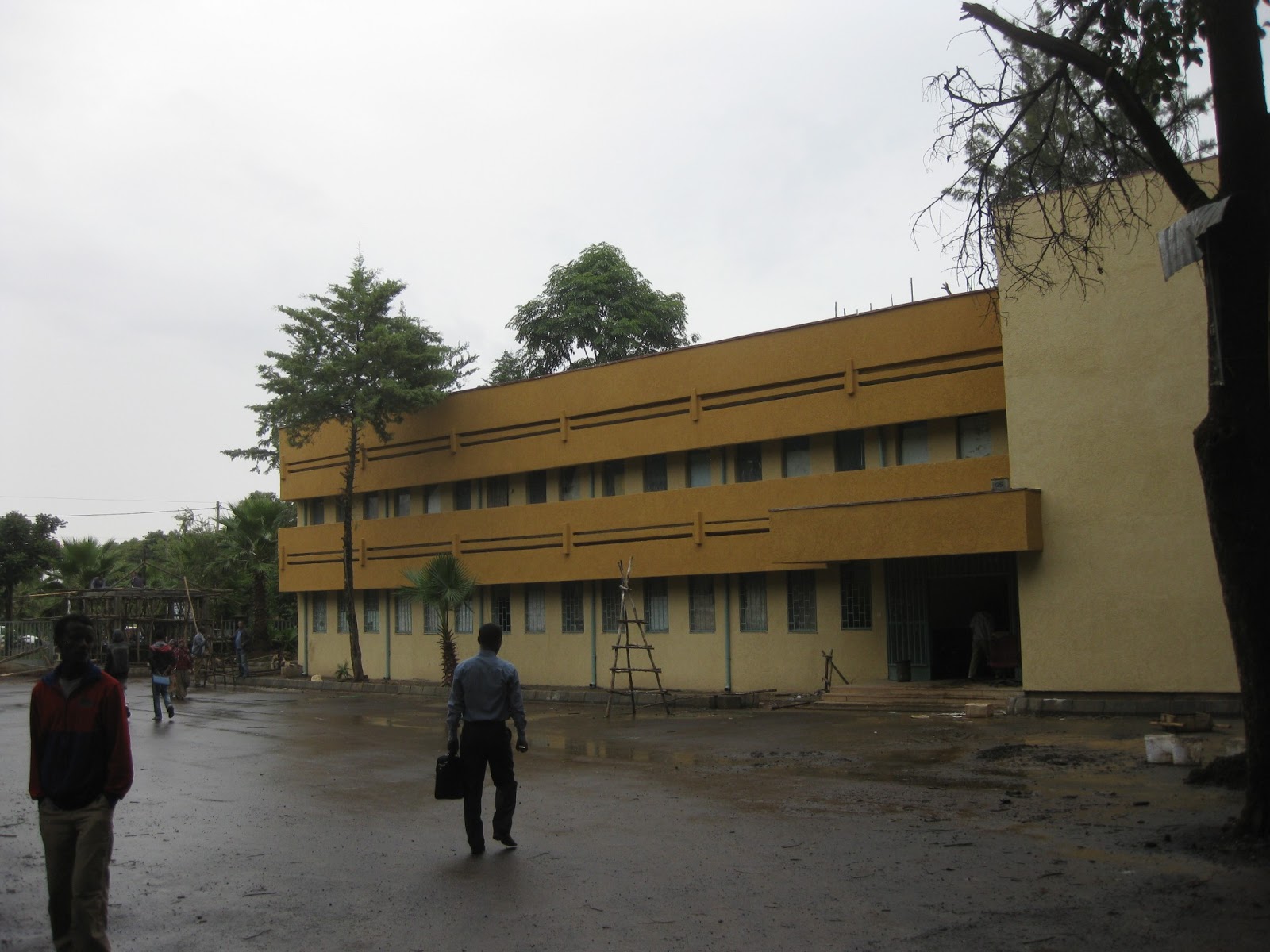
The work part of the trip started at the Amhara Regional Bureau of Agriculture:

That was followed by a trip to maize fields!


We stopped at several points to talk with farmers. The picture below shows a field where weeding is half-complete. We asked the farmer (not pictured) about the new system being piloted for maize seed distribution:


We visited several primary cooperatives, including the one below. These distribute seed and fertilizer to smallholder farmers, and often purchase their output as well:


We stopped at this Farmer Training Center to meet with the development agents: 


However, the road in and out was nearly impassible:

 Distribution of inputs (DAP fertilizer) at another Primary Cooperative:

Large-scale storage facilities at a Cooperative Union (parent of the primary cooperatives):

Overall, I covered 1,000 kilometers in 7 days. (Note that Google's drive time estimate below is extremely inaccurate under Ethiopian road conditions):

Sunday, July 21, 2013

What I'm homesick for / the lure of frictionless consumption

I made a commitment that my next post would include photos. Unfortunately, I'm going to delay that for one more post, hopefully early this coming week, once I have better upload bandwidth (sorry John O'Connor!). In the meantime, here's a post that is less about Ethiopia, and--I guess--more about me.

Caveat, the conclusion of this post may feel a little political:

The other week I had a moment at work where I really and truly wanted nothing more than to be able to step out for a brief moment; grab a quick, easy, custom-made, and familiar sandwich from Mike's Cafe; and make it back within 10 minutes to eat it in the office.

For the most part I've avoided too much homesickness while in Addis. To different degrees this could be attributable to the fact that I'm still in a "honeymoon period" (coming up on the two months mark!), that I was ready to leave DC, that Addis isn't as lacking in familiar comforts as might be expected--if you know where to look, and that my expat colleagues before me have figured out exactly where to look.

Still, I've been putting thought on occasion into what it is I really miss from "home" and why.

1) Summer -- The rainy season in Addis has not hit me as hard emotionally as I was warned it might. Twelve weeks (now half-passed) of a couple hours of rain daily and a little mud to walk through doesn't forebode for me as much as the dark and cold of November entering into a New England winter. And, in terms of weather specifically, I'm willing to take up the bargain that Ethiopia will more than make up for this briefly sub-optimal weather with sun and moderate temperatures the entire rest of the year. (Especially when I know folks in the Northeast US are suffering: even three years in, I was still feeling lucky to take advantage of a mild DC winter that wasn't Boston's or Ohio's).

Still, certain things about summer in the US I unequivocally miss not being able to take in. Mainly these have to do with summer days spent on Kelleys Island, Ohio: views of the lake, placid ferry rides, steak from the barbecue, corn on the cob, outdoor drinking, and the general feeling of languor that accompanies all these summer luxuries. I understand, though, that it's been an unusually hot summer so far in the US--one that makes you want to stay inside, turn up the AC, and interferes with some of these simple pleasures. And even more so with my next desire...

2) Outdoor exercise -- Biking up into Rock Creek Park, down across Memorial Bridge to the airport, or even across to downtown or unknown parts of Northeast was a favorite way of mine to kill time in DC while not giving in to complete laziness. This would be a more difficult and (likely) less enjoyable pursuit here for any number of reasons. In particular, I'm thinking lack of quality roads and parks, difficulty getting ahold of the required equipment (bikes aren't a thing here even for urban commuting), conspicuousness of a ferengi engaging in something laborious for personal enjoyment (although, unlike in India, running is a recognized thing here and so this might be less of a hurdle).

While I'm on some level skeptical of a lot of the outlets for enjoyment available to young American urbanites, this was one of the several that I nonetheless got substantial enjoyment out of. And another was...

3) My apartment -- My apartment in DC was pretty damn awesome. Lots of square feet; wood floors; light; views; outdoor space; modern conveniences; proximity to public transport; walkability to--if not actual presence in--legitimately interesting parts of DC (sorry Foggy Bottom); and less than two blocks from all the conveniences of modern yuppy life--Whole Foods & Trader Joe's, CVS, grab-and-go quasi-gourmet burgers, salads, and sandwiches. Which leads to...

4) Friction-less consumption -- This is to some extent a catch-all bucket. At times I can miss many of the things that were easy to get ahold of someplace I've been recently and no longer are: chai tea lattes, respectable sandwiches, and a chattering crowd at a hip coffee shop in DC (Tryst basically); Vietnamese, Japanese ramen, and fresh seafood options; coherent neighborhoods to walk around in--whether in DC, London, or San Francisco--that are held together by the fact that someone else is there to buy the overpriced food, art, or whatever else.

I desire what I don't have--in my prior situation I missed the novelty and immediacy of life in a foreign place, and now I miss the comfort and distance of an American suburb. At a more material level, I miss a world that has become very good at serving up whatever I desire at a particular moment with limited hassle--whether it's combining the elements of a quick meal at the Whole Foods hot food bar, ordering the exact right green tea off of Amazon, or finding an alright movie on Netflix to kill some time.

My experience in Addis tells me that this form of consumption hasn't reached the entire world. Fulfilling a particular consumer desire/demand often takes a lot more input and effort here, for better or for worse. There's no self-checkout, no walking into Target and walking out with prescriptions and trail mix and jeans and furniture, no one-click purchase then putting it out of mind until it shows up two days later.

Transactions involve explicitly formulating your desires, strategizing over how to fulfill them, and--invariably--interacting with actual people at the point of sale. My colleagues know exactly which expat supermarket will sell particular "staples" (for instance Parmesan cheese, disposable cups, frozen chicken breasts). You'll have to bargain for a taxi there and a taxi back. And you'll generally have to stop at smaller individual stands and shops to fill out your basket--bread, fresh produce, etc. coming from their own individual proprietors.

Some of the friction comes from being foreign and not used to it (e.g. it's not as easy to negotiate for taxis), some of it comes from the economy being not used to me and the goods people like me desire (e.g. quick, customized lunch sandwiches in the Mike's cage example above), but some simply comes from being in a less automated and less streamlined economy (see Whole Foods, Amazon, Netflix, Target above). In a way this raises prices for everyone, by adding on a layer of "hassle" in addition to the monetary cost of goods. (Those with servants to do their shopping for them--which was common in India, and seems common here though on a less full-service model--may manage to substitute most of this hassle cost with an additional monetary cost).

It reminds me that many of the accomplishments of the American retail sector over the past 50 to 100 years (really as far back as the Sears catalogue) and the American technology sector over the past 20 have been to remove this sort of "hassle" cost and make the sole cost of a purchase its monetary cost, as in the examples of big box stores, self-checkout, and one-click shopping noted above. This is no doubt efficient in a specific sense, and is positive for someone like me who enjoys consumption and dislikes instrumentalized human interaction as a barrier to it.

Some would say that this removal of "friction" is good for all in the long-term, as it's inherently something without a net benefit. Others might counter that a trend toward not having to formalize, strategize around, and then communicate your desires is dangerous to society in a variety of ways--a push toward thoughtless consumption, as well as social inequity. 

Without coming down one way or the other on that, as a hallmark of the society I'm used to, I miss it.

Sunday, June 30, 2013

Atmospheric Details

There's a lot of aspects of day-to-day life that I haven't spent much time on in previous posts. Below are some topics that seem to come up in any guide or introduction to Addis and/or Ethiopia. (While this draws mainly on my own personal knowledge/observations, I'm not yet at the point where I can confidently tell you what the guides tend to get wrong.) 
  • Weather: Despite being just north of the equator, Ethiopia does not have the "tropical" climate that one reflexively envisions. The altitude of Addis, and perhaps some macrogeographic features that I'm not familiar with of the country as a whole, mean high's more-or-less in the 70's year-round. And the "less" is actually around this time of year: despite being in the Northern hemisphere, we're heading into Ethiopian "winter"--the rainy season. In recent weeks, brief torrential downpours have become more common, occurring nearly everyday, often in the mid-afternoon. I've been told July is the worst, so things will get worse before they get better. Nonetheless, it's been sunny almost every morning, so I am not yet experiencing the Vitamin D deprivation of, say, a Boston winter.
  • Calendar: Ethiopia has its own calendar which, if I understand correctly, is more or less equivalent to the Julian calendar rather than the more recently adopted (e.g. circa 16th century) Gregorian calendar. By this calendar the year is something like 2006 -- which can make figuring out which calendar is being used confusing when one sees a date in, for instance, government documents. The calendar also has 13 months which has been used as a basis for the tourist slogan "13 months of sun" -- conveniently ignoring the above-mentioned rainy season.
  • Food: The staple of Ethiopian food is injera, a spongy pancake made from tef, which is a grain grown basically only in Ethiopia. (When agriculture people talk about tef, there is a tendency to mention that it's now grown in the Netherlands--and I've once heard even Ohio--and that it may have growth potential in the west by virtue of being gluten-free). Injera is gray and slightly sour, and the other components of a meal are served on top of it, with the injera used to pick and sop them up without the help of additional utensils. Injera is seen as a piece of the Ethiopian soul--jokes are made about its supposed addictive qualities, and Ethiopians will often assume that as a foreigner you might miss your own customary bread and want to eat it at each meal. Common dishes to go on top of injera include shiro, an orange paste made of powdered chickpeas; tibs, basically chunks of cooked beef; and bayonetu, an assortment of vegetable dishes. Ethiopian Christianity calls for "fasting" -- meaning no meat/eggs/dairy on something like 40% of the days of the year, including an extended lent as well as most Wednesdays and Fridays. On these days bayonetu is easy to find, and on others not so much (as with non-vegetarians in India, when meat is both allowed and something that one can afford, the assumption seems to be that one would desire little else).
  • Language: Amharic is written in its own destinctive script and is a Semitic language -- which apparently makes it easier to learn for people unlike me who have studied either Arabic or Hebrew. My employer sponsors lessons -- one a week individually, or more if you combine with others. So far I've managed to have two, and can do little beyond greet people.
  • Transport: The typical ferengi (foreigner) transport option here are the ancient blue and white cars which serve "contract" taxis. No fuel subsidies in Ethiopia (part of what keeps taxi rates in other parts of the developing world low) mean that the price you might pay over a given distance is half--and not some fraction of--what you'd pay in the US, though an Ethiopian will also tend to pay less. That said, a much more common transport option for locals--and also refered to as "taxis"--are the (also ancient, also blue and white) minibuses following fixed routes between central points in the city. Along these routes, minibuses will slow at the sight of potential passenger, swing open the sliding door, and the ticket-taker will barrage you with the name of that line's destination -- "Bole bole bole bole". A minibus costs under 2 birr (10 cents) for a distance that might be 50 birr in a contract taxi. Beyond the minibuses, public transport options are limited: red and yellow full-size public buses follow a few routes within the city center -- they conspicuously lack in emissions control mechanisms and I've been told led their first lives in 1970's Holland; a light-rail line is apparently under constructed as well, contracted out to a Chinese firm. But most locals walk. Often, given the frequent lack of sidewalks, this means walking in the road. Some transport options I'd expect to see are actually uncommon: Three wheelers (auto rickshaws/tuk-tuks, called Bajaj here for their Indian manufacturer) are banned from most of Addis, and one rarely sees bicycles of motorcycles either -- Ethiopians I've asked say they wouldn't feel safe on them, but I wonder if there's a more structural explanation as well.
  • Women: Ethiopia and those who describe it often makes a claim to have "the most beautiful women in the world." This is obviously a matter of personal preference, but I wouldn't say its baseless. Ethiopians in general, while their appearance is clearly African, perhaps show some Middle Eastern traits as well (which would certainly be in accord with the cultural sphere). These two statements are probably as far as I want to go either on the topic of attractiveness or in making generalizations about appearance at the national level. In terms of clothing, women in Addis appear to follow a relatively conservative dress code, with flowing white scarfs and a generally more traditional impression, while men are more westernized in appearance.

Sunday, June 23, 2013

Adama, Football, and the Institutional Environment

Between a busy couple weeks and a desire to catch up on Mad Men, I'm running out of time in the window I had set aside tonight to bring my blog up to date. (By the way, if you want to stay up to date on this blog but with minimal effort, there's now a box at bottom to subscribe to future updates by e-mail).

Last Sunday, it was the outbound leg of another work trip that cut into my blogging time. The destination was Adama, a city 100k southeast of Addis that--startlingly in a country of 90 million people--is the country's third largest city with a population of only 250,000. A population that's 80% rural will tend to do that. (I should also note that all of these numbers are approximate at best.)

A few other interesting facts about Adama:
  • It was renamed Nazret (Nazareth) by the then-Emperor in the mid-20th century. He was apparently on a biblical-naming kick to emphasize his line's claim of descent from Solomon (the Christian aspect of Ethiopian history is fascinating). The name Adama was only re-instituted in 2000 and you hear Ethiopians call it both.
  • For a few years in the last decade, the city was made the capital of Oromia, Ethiopia's most populous state. The capital has since been moved back to Addis. Needless to say, it sounds like there's some politics behind this--in particular the account I've heard is that the move was meant to duly reward and punish areas supportive and less so of the national powers that be.
  • Due to this political episode, the road into town passes several fancy new complexes that from the air at least could pass remarkably well for a UFO staging area. For the sake of completeness, I believe the image below shows a monument to the ruling party (full circle in the top middle-right--the center of the circle contains a pair of joining hands), the regional government center (semicircle below--I'm told these facilities are still used sometimes), the regional court of justice (I think this may be the large parking lot with the smallish cluster of buildings just below the bottom traffic circle), and a fourth complex (no recollection of a sign for this one).

View Larger Map


There's not too much to recount from the three days I spent in Adama -- much of it was passed in Amharic-language meetings. Two recollections deserve mention, however, and both come from the Sunday afternoon we first arrived in town. One involves football (soccer) and the other a conversation with a colleague.

We arrived around 4:30 PM and just as the first half of an Ethiopia-South Africa world cup qualifying draw was ending. An Ethiopia win would clinch the qualifying group and send the team through to the final round--a home and home series against a yet-to-be-determined opponent. A loss would put South Africa in the group lead, in prime position to deny Ethiopia advancement with only one game left.

Running may be the de facto national sport of Ethiopia, but with the stakes this high (Ethiopia had never advanced to a World Cup or even been this close), the nation was riveted. We'd been listening by radio in the car as South Africa got off to a dominating start and a 1-0 lead. But as we contracted our rooms for the night ($20/night for a pleasant, clean room with good light and satellite TV), Ethiopia equalized on the black-and-white TV in the lobby, scoring on a well-placed shot off a solid cross.

I spent the next hour in the bar, behind an intent mass of Ethiopians, watching Ethiopia take the lead on a devastating own goal for South Africa, and then hold on through the final minutes. The group in the bar erupted, though it was no match for the frenetic joy in the scenes from the stadium in Addis where the match was played. (Some friends tried and failed to get tickets--they went on sale at noon on match day, went for as low as 50 cents, and the only reliable way to procure them was to wait on line for several hours).

Walking around later, it was clear the whole city shared in expressing the celebratory spirit, to the extent that one of my colleagues commented that he wasn't sure people were aware that this had clinched only advancement to the next qualifying round, and not the World Cup birth itself. Much of the enthusiasm consisted of crowds of young men blocking the street to slow passing vehicles--allowing them to climb aboard and ride along the tops and sides. I didn't bring a camera to Adama, but the below scene of similar merry-making comes from a friend in Addis:
(Credit for this photo goes to Hayoung)


Unfortunately--with apologies to anyone who already knew this and has nonetheless been waiting this long for me to reveal it--it emerged the next day that Ethiopia had, in their prior match, played an ineligible player. They were forced to forfeit 3 of their points and their lead over South Africa is no longer unassailable. Still, a win in the next game--which comes in September and in which Ethiopia will face a weaker opponent--will propel Ethiopia through and provide reason for another such celebration.

My guide for this walk around the city was an Ethiopian coworker, a senior agronomist, who seemed somewhat bemused by the level of excitement. The second notable takeaway from the day were was his backstory as it came out of over the course of our walk. While I won't presume to tell it in full here, some interesting fragments include:
  • When he received higher education in the 1970's, there were only two universities in all of Ethiopia. There are now over 30.
  • Under the prior regime, he had the opportunity to study in Eastern Europe under the iron curtain. With the emergence of the current regime, the geographic alignment shifted and he studied in America and Europe.
  • He sees sustained peace, more than anything else, as the driver of recent growth in the country.
I'm not doing this conversation justice--and perhaps can't without giving a more in-depth recounting than I'd like.

To me, the common thread among my takeaways is the extent to which the fundamental institutional environment of this country has seen staggering change (geopolitical realignment, stability, etc.) within the timeframe of a lifetime rather than a historical epoc. Though there do appear to be continuities as well, the scale of the change marks it in contrast to recent US history. (I'd also note that, as a young person, I still have a sense of permanence around the set of things and circumstances I've been acclimated too, which may lead me to underestimate the degree of intra-lifetime--vs. historical-scale--change that is "normal" in today's world.)

To back off on the jargon, the current conventional wisdom on Africa holds that, while there's a long way to go, things are moving fast here in a way that few would've imagined a decade ago and many still don't realize. If I wanted to be a good blogger and tie everything in this overlong post neatly together, I could claim that Adama, Ethiopian football, and my conversation takeaways all--in one way or another--provide another grain of evidence for this view.

Sunday, June 09, 2013

What have I been reading?

Before leaving for Ethiopia, I picked up several books on the country. So far I've read:
  • A History of Ethiopia (Updated Edition) This was a fairly academic history. After struggling through several chapters trying to get a visual map of the different tribes and dynasties involved, the modern history was much more relatable, if not cheerier.
  • The Emperor A journalist's lyrical account reconstructing the last days of the Imperial reign inside the palace in Addis Ababa. Most memorable part was looking up the journalist afterwards and seeing he'd been revealed to be a spy/collaborator with the Polish secret police.
Last weekend, I had lunch at Lime Tree, a very expat focused cafe (menu includes humus/mezza, Indian thalis, lots of sandwiches and pizza, plus they do Wok Wednesday and Tex-Mex Tuesdays/Thursdays). Afterwards, I stopped by the attached "BookWorld" and picked up some local English-language periodicals.

Having read through most of these on the trips to and from Awassa, I feel I've learned something about both 1) the local news environment and 2) current debates around the direction of Africa's economy and politics (there was a lot of Pan-Africanism talk, which links to the recent 50-year anniversary of the African Union, celebrated in Addis).

For now, though, you get the superficial descriptions I jotted down before making my way through these fine publications:
  • The Reporter Motto: Free Press Free Speech Free Spirit, Logo: "Rescue Press freedom from the hangman's noose" with aforementioned hangman, noose, victim, and stool being kicked away. Nothing in here actually felt too controversial
  • Ethiopian Weekly Press Digest Each section is split into "In government media" and "In private media"
  • ZOMA: Addis Ababa's Monthly Magazine This glossy seems to aim for the Lifestyle Magazine segment. Cover stories include "The African Union and the Changing Faces of Security Threats in Africa" and "Hip-Hop for Social Change"
  • Ethiopian Business Review Cover story : From Doom to Bloom, top bar: "The Man with 900 Million Dollar," touting an exclusive interview with the representative of the African Development Bank
For what it's worth, I've also been reading travel guides, briefing documents for work, lots of nytimes.com to feel connected, and--intermittently--Tony Judt's Thinking the Twentieth Century.

A Journey

I made my first trip out of Addis this past Monday. It was a work trip, and my most recent work trip before this was to Topeka, Kansas, so this was a little different.

I went along with a local ATA analyst to attend a "lessons learned" workshop the next day in Awassa, a regional capital 300 km south of Addis, in the Great Rift Valley, that's known for its picturesque lake and its large university. I got lucky and we largely took the "scenic route" from Addis -- a two-car wide strip of Asphalt through recently-planted fields (many of them growing maize!) and shrubby hills that can be faster than the congested "main road," which we picked up toward the end and which goes through village after village. In our time on both roads we occasionally had to slow for herds of cows and goats.

Awassa is apparently a weekend destination for Addis's middle class. We found a new, rectangular hotel near the lake, outfitted with Chinese-made modcons (the TV remote, for instance, had no English or Amharic in evidence). A brief evening walk along the lake shore -- past shacks offering pool tables and fish fries which were largely deserted on a Monday -- led to the picture below.

The next day's workshop was entirely in Amharic (which is the main official language of Ethiopia, although English is apparently a standard part of the curriculum and is the language of big business). Beyond getting to introduce myself -- Ene Max Kornblith ebalalau. Ke ATA nau yehmeh tahut ("I am Max Kornblith. I come from ATA.") -- I was fairly useless. Most of the other attendees were managers of farmers cooperative unions, and the project being discussed--which is a major one for my team--is something you can read more about here via the Huffington Post.

The trip back was uneventful -- i.e. I slept most of the 4-hour drive. Overall, I'd say it was a successful trip.

Below: Lake Awassa at sunset
Bottom: Central Hotel Awassa, location of the lessons learned workshop


Monday, June 03, 2013

In the news

So if I'd gone for my walk up North one day later, it could've been a quite different experience.

Didn't hear about this anywhere today but BBC on the hotel TV today (I'm still in something of a bubble), but the flyering I saw going on yesterday makes more sense now.

Sunday, June 02, 2013

Q&A

Thanks to Sonum for the questions

1.Living: So how is your place?
I'm still in a hotel. Looking to move out in a week to fill-in in the shared house of a colleague who'll be back in the US through end of June. I've looked at a couple options after that point -- both involve taking a room in an existing set-up of development professionals. One was a quite pleasant house, the other an apartment somewhat more convenient to work. (The commute vs. quality of housing trade-off has followed me to Addis.) Both are in a price-range inaccessible to all but the most well-off Ethiopians, and comparable to what you could pay in less popular US cities.

2. Work: How are the people? Is the office space nice?
Everybody's nice so far. Obviously I still don't quite feel like I know what I'm doing. Both the locals and the foreign hires generally seem welcoming and qualified.

The office itself is perhaps surprisingly "normal." Same laptop docks, monitors, etc. as at my old job and potentially better furniture. We're on the eighth floor, have lots of light, free tea and coffee and people who clear the cups from your desk (which means no more Coke Zero can pyramids--although this is triply true here since soda comes in glass bottles and basically all the Coke is Classic).


3. Addis: What do you think of the city?

Some numbers

Estimated GDP per capita (all figures approximate and expressed in current US dollars at Purchasing Power Parity):

Ethiopia (2012): $1,200

Addis Ababa (~2010): $1,100

India (2012): $3,900
Delhi (~2010): $11,000

US in 1800: $1,600

US in 1900: $6,600
US in 2012: $50,000

Caveats: GDP is not a perfect measure of economic prosperity. Among other shortcomings, as a mean (straight average) it doesn't try to capture the "typical person's" economic situation and can be skewed upwards by inequality that benefits relatively few people. Additionally, the Delhi GDP figure sounds quite over-stated to me, possibly due to not acknowledging the lesser value of the rupee in Delhi vs. the country as a whole. (For those of you wondering, the Ethiopian currency is the birr, by the way, and currently sits at about 18.5 to the dollar).

Sourcing: Addis GDP is drawn from city reports and personal conversion. Source for all other figures is Wikipedia. Historical US data also used help of usinflationcalculator.com to take 2000 dollars to 2012. 

Some photos


Above: View to the Northwest from 10th floor window of the Hotel de Leopol International, Addis

Below: Standard Room at the de Leopol (Promotional photo. Not pictured: intermittently functioning shower, 70's-era white tiger-themed lounge bar.*)


*Also not pictured: reason for seemingly naming your hotel after one of the worst colonial madmen in African history